Top Solid Wood Furniture Sets Manufacturers in China

Time:2026-09-21 Author:Liam
0%

China’s position in the global furniture industry deserves closer examination. CSIL’s World Furniture Outlook 2024 identifies China as the world’s largest furniture producer and exporter. Its scale supports advanced woodworking, finishing, packaging, and supply-chain coordination.

Yet scale alone does not guarantee dependable Solid Wood Furniture Sets. Buyers still need to inspect timber species, moisture content, joint construction, surface coatings, and replacement support. The FAO’s Global Forest Resources Assessment 2020 reports that forests cover approximately 31% of the world’s land area. This figure reinforces the importance of responsible sourcing, traceability, and material efficiency.

Design communicates intention.

As architect and sustainability advocate William McDonough has said, “Design is the first signal of human intention.” For solid wood furniture, that intention appears in visible grain, hand-sanded edges, stable table legs, and finishes that protect without hiding the material. It should also appear in certification records and clear factory documentation.

The manufacturers reviewed in this guide are not judged by catalog photography alone. Their practical experience matters: kiln-drying control, tolerance management, sample consistency, and careful export packaging can determine whether a dining set arrives ready for daily use. China National Furniture Association industry information also shows how competitive and diverse China’s furniture manufacturing base has become.

Some claims remain difficult to verify.

Supplier websites may describe “premium wood” without naming the species or grade. That weakness deserves attention. This guide therefore considers manufacturing capability, product quality, sustainability evidence, customization depth, and buyer communication. The result is not a perfect ranking, but a practical starting point for evaluating China’s leading Solid Wood Furniture Sets manufacturers.
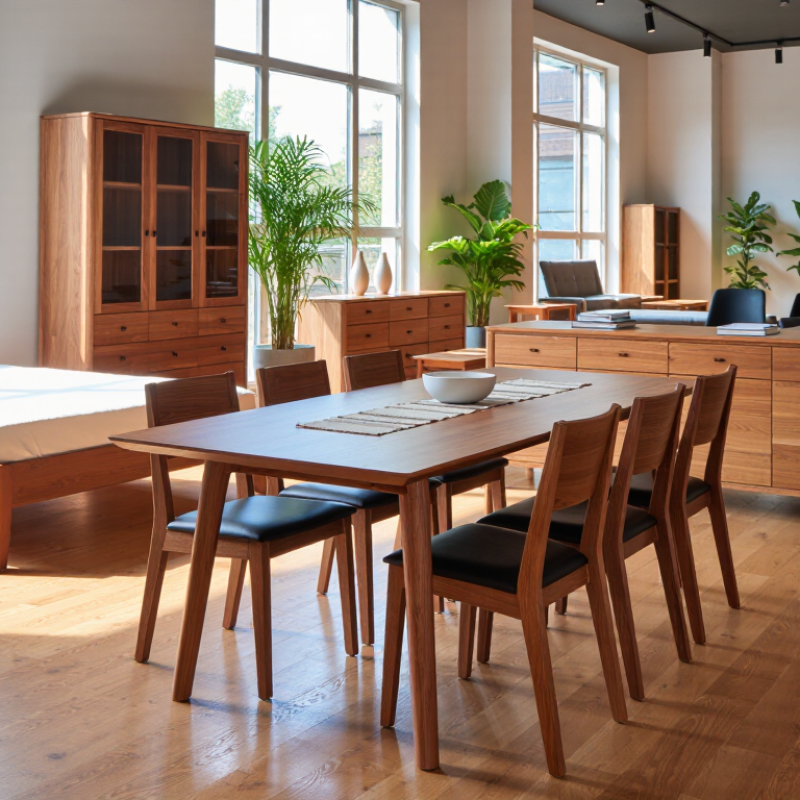
Top Solid Wood Furniture Sets Manufacturers in China

Definition and Scope of Solid Wood Furniture Sets

Solid wood furniture sets are coordinated groups of household pieces made mainly from natural timber. A set may include a dining table and chairs, a bed and nightstands, or a sofa table with matching storage units. Each main structural part should use solid wood, rather than only a thin wooden surface. Small components may include metal hardware, glass, fabric, or engineered panels. These supporting materials do not automatically disqualify the set.

The scope also covers different wood species, joinery methods, finishes, and room applications. Manufacturers may offer oak, ash, pine, rubberwood, or other responsibly sourced timber. Appearance varies with grain, knots, moisture movement, and finishing methods. These details affect durability and visual consistency. Veneer furniture is different because its natural wood layer covers another core material. Mixed-material products need clear descriptions, especially when only the frame is solid wood.

A reliable evaluation examines more than photographs. Ask for material specifications, moisture-control procedures, joint construction, finish details, and production samples. A useful check is comparing the stated wood type with visible end grain and panel edges. The boundary is not always clean. Some suppliers describe a set as solid wood when several hidden panels are composite. That wording can create confusion. In practical sourcing work, written specifications and inspection records remain more dependable than attractive catalog language. Small defects may still appear, such as uneven grain or minor color variation. These are natural features, but poor alignment or unstable joints require closer review.

Key Factors for Evaluating Chinese Furniture Manufacturers

Top Solid Wood Furniture Sets Manufacturers in China

Evaluating Chinese solid wood furniture manufacturers requires more than comparing catalog prices. Examine the factory’s production experience, material control, and quality records. Request wood species details, moisture readings, and sourcing documents for every major component. Oak, ash, rubberwood, and walnut behave differently in changing climates. A credible manufacturer should explain those differences clearly.

Ask for a physical sample, not only polished photographs. Inspect drawer joints, table edges, back panels, and the underside of each piece. Look for uneven stain, open knots, loose hardware, or sharp corners. Check whether panels are solid wood or veneered composite material. Factory visits can reveal useful details, including dust control, storage conditions, and worker inspection routines. My own evaluations have missed small defects before.

Reliable communication is another practical test. Request a detailed quotation with dimensions, wood grades, finishes, packaging, and replacement procedures. Confirm production capacity through recent orders and sample timelines. Independent testing for formaldehyde emissions, coating safety, and structural performance adds valuable evidence. Export documentation should match the shipment and destination requirements. Be cautious when a supplier promises everything immediately. Fast answers are convenient, but careful answers are often more trustworthy. A strong manufacturer will accept reasonable questions, document changes, and explain what cannot be guaranteed.

Top Solid Wood Furniture Sets Manufacturers in China - Key Factors for Evaluating Chinese Furniture Manufacturers

A practical, evidence-based evaluation framework for comparing solid wood furniture manufacturers without relying on company or brand names.

Evaluation Dimension What to Verify Recommended Evidence Practical Benchmark Suggested Weight Scoring Guide
Solid Wood Transparency Species, wood origin, solid-wood percentage, and the use of veneers, MDF, or particleboard. Material specification, purchase records, product cross-sections, and a written bill of materials. Every solid-wood component should be clearly identified; engineered panels should never be described as solid wood. 15% 1–5 points
Timber Legality and Traceability Whether the timber supply chain can be traced from the processor or importer to the finished product. Supplier declarations, chain-of-custody records, invoices, harvest documentation, and certification documents where applicable. Traceable species and source documentation should be available for every major timber batch. 12% 1–5 points
Moisture Control Wood moisture content at production, assembly, and pre-shipment stages. Calibrated moisture-meter records, inspection procedures, kiln-drying records, and shipment inspection reports. A common target for indoor furniture is approximately 8–12% moisture content, adjusted for the destination climate and product design. 15% 1–5 points
Joinery and Structural Strength Joint design, load-bearing performance, hardware quality, and resistance to loosening during use. Engineering drawings, assembly instructions, load-test records, prototype reports, and inspection samples. Joints should be mechanically stable, accurately machined, and tested for the intended load and use frequency. 14% 1–5 points
Surface Finish and Chemical Safety Finish durability, coating consistency, odor, restricted substances, and suitability for indoor use. Finish technical data sheets, laboratory test reports, coating batch records, and applicable chemical-compliance declarations. The selected coating should match the buyer’s market requirements for emissions, restricted substances, abrasion, and moisture resistance. 12% 1–5 points
Quality Management System How consistently the factory controls incoming materials, production, inspections, and corrective actions. Quality manual, inspection checklists, nonconformance records, corrective-action reports, and third-party audit results. A documented quality system with measurable acceptance criteria and traceable corrective actions is preferred. 10% 1–5 points
Production Capacity and Lead Time Actual capacity for complete furniture sets, seasonal availability, tooling, and production scheduling. Capacity plan, recent production records, sample-to-production timeline, and confirmed lead-time commitments. Capacity claims should be supported by recent, comparable orders rather than by maximum theoretical output. 8% 1–5 points
Customization Capability Ability to modify dimensions, wood species, color, hardware, packaging, and set configurations. Approved drawings, sample-development records, prototype timeline, and change-control procedure. A capable manufacturer should confirm drawing revisions, sample approval, tolerances, and change costs before mass production. 6% 1–5 points
Packaging and Export Readiness Protection against impact, abrasion, humidity, and handling damage during international transportation. Packaging specifications, carton test results, drop-test records, container-loading plan, and export documentation samples. Packaging should be validated against product weight, fragile surfaces, stacking conditions, and the intended shipping route. 5% 1–5 points
Sustainability and Factory Compliance Legal employment practices, environmental controls, waste management, energy use, and responsible material sourcing. Factory audit report, environmental permits, waste-disposal records, worker-safety procedures, and sustainability certificates where applicable. Evidence should be current, site-specific, and consistent with the factory’s actual production activities. 3% 1–5 points

How to use this table: Score each dimension from 1 to 5, multiply the score by the suggested weight, and compare the weighted totals. Verify all claims through samples, documents, factory audits, and pre-shipment inspections before placing a commercial order.

Leading Solid Wood Furniture Set Manufacturers in China

Leading Solid Wood Furniture Set Manufacturers in China are gaining attention as buyers seek durable, coordinated interiors. CSIL’s World Furniture Outlook 2024 identifies China as the world’s largest furniture producer and exporter. The report also shows that international furniture demand remains sensitive to housing cycles and freight costs. This makes manufacturing consistency more important than low pricing.

Experienced Chinese manufacturers usually manage timber selection, kiln drying, machining, assembly, and final inspection in one system. The Forest Stewardship Council reports that certified forest areas worldwide exceeded 160 million hectares in 2023, giving buyers a useful traceability benchmark. However, certification alone does not prove excellent furniture. Buyers should request moisture readings, hardware specifications, surface-finishing details, and independent safety test reports. Small details matter.

Tips: Ask for a complete production sample before placing a large order. Check joint strength, drawer movement, odor, and color variation. Review packaging photos, not only showroom images. A reliable factory should explain its inspection records clearly. Some suppliers still describe “solid wood” too broadly, including engineered panels in hidden sections. That wording can create disputes. I would also compare three quotations with identical specifications, because a cheaper offer may simply exclude drying, testing, or protective packaging. Leading manufacturers are not always the largest; responsiveness and documented process control often reveal more.

Top Solid Wood Furniture Sets Manufacturers in China — Material Benchmarks

This chart compares the Janka hardness of commonly used solid wood species in furniture manufacturing. Higher values generally indicate better resistance to dents and surface wear, while lower values are often easier to process and suitable for lightweight furniture sets.

Manufacturing Standards, Materials, and Quality Control

Reliable solid wood furniture begins with controlled manufacturing standards, not attractive showroom photos. In factory assessments, I check timber records, drying procedures, and production tolerances. Properly kiln-dried wood usually reaches 8–12% moisture for indoor use, depending on the destination climate. This reduces cracking, warping, and joint movement. Workshops should also follow documented safety, coating, and chemical-emission requirements. Paperwork matters, but shop-floor evidence matters more.

Material selection affects both service life and appearance. Oak, ash, walnut, and rubberwood each respond differently to humidity, weight, and machining. Clear grain can look impressive, yet small knots may not indicate weakness. Responsible manufacturers separate structural pieces from decorative panels. They inspect boards before cutting. That simple step prevents expensive waste. Reclaimed wood can add character, but its origin, treatment history, and moisture condition require careful verification.

Quality control should continue after assembly. Inspectors can measure joint gaps, surface flatness, drawer alignment, and chair load performance. A consistent finish needs checks for color, adhesion, odor, and edge coverage. Samples should be tested under realistic handling, not only photographed. No factory is flawless. I have seen excellent furniture leave one careless sanding mark unnoticed. That is why independent inspections, batch records, and corrective-action reports remain useful. A supplier becomes more trustworthy when it records failures honestly and changes the process afterward.

How to Select a Suitable Chinese Furniture Supplier

Top Solid Wood Furniture Sets Manufacturers in China

Selecting a suitable Chinese furniture supplier requires more than attractive catalog photos. According to UN Comtrade data, China exported roughly US$74 billion in furniture under HS 94 in 2023. This scale offers choice, but it also makes verification essential. Request factory photos, production records, and recent inspection reports. Check whether the workshop controls timber sourcing, kiln drying, moisture testing, and final assembly internally. Ask for a small sample set before discussing large-volume orders.

Material details reveal practical experience. Solid wood should be identified by species, grade, and moisture range, not simply called “natural wood.” For many indoor environments, 8%–12% moisture content is a useful reference, but climate changes the target. Require test evidence for coating safety and formaldehyde emissions under the destination market’s standards.

The supplier should explain joint construction, panel movement, repair procedures, and packaging tests. Vague answers deserve caution.

The 2024 CSIL World Furniture Outlook identifies China as a major global furniture production and export center. That authority does not prove every factory is reliable. Visit the facility, or use an independent auditor. Inspect sanding dust, glue lines, drawer alignment, and carton edge protection. Very low pricing can hide thinner components or rushed drying. I have seen polished samples conceal weak backs and uneven doors. That mistake is easy to make. Compare three quotations using the same specifications, tolerances, warranty terms, and inspection points. Keep written records. Suppliers may agree verbally, then remember differently.

FAQS

What should buyers examine when evaluating a Chinese solid wood furniture manufacturer?

Review production experience, material control, inspection records, and communication quality. Ask for evidence, not polished promises.

Which wood details should a manufacturer provide?

Request wood species, grades, moisture readings, and sourcing documents. Oak, ash, rubberwood, and walnut react differently to climate changes.

Why is a physical production sample important?

Photos are not enough. Inspect drawer joints, table edges, back panels, and undersides. Small details matter.

What defects should buyers look for in samples?

Check uneven stain, open knots, loose hardware, sharp corners, and sticking drawers. These flaws may appear after delivery.

How can buyers confirm whether furniture is truly solid wood?

Ask which sections use solid wood and which use veneered composite panels. “Solid wood” can describe hidden sections too broadly.

What factory conditions deserve attention during a visit?

Observe dust control, timber storage, kiln-drying records, assembly areas, and worker inspection routines. A clean showroom proves little.

What should a detailed quotation include?

Confirm dimensions, wood grades, finishes, hardware, packaging, production timing, and replacement procedures. Compare three quotations with matching specifications.

Which safety and export documents should buyers request?

Request independent reports for emissions, coating safety, and structural performance. Shipment documents should match destination requirements.

How can buyers judge production reliability?

Compare recent orders, sample timelines, and inspection records. Fast answers help, but careful answers may be more trustworthy.

Are large manufacturers always the best choice?

Not necessarily. Responsiveness and documented process control can matter more than factory size. My own evaluations have missed small defects before.

Conclusion

This article presents a practical overview of Solid Wood Furniture Sets, covering their definition, common applications, and the value of using natural timber in coordinated home and commercial interiors. It explains how buyers can evaluate Chinese furniture manufacturers by examining production capacity, craftsmanship, customization services, material transparency, certifications, communication, lead times, and after-sales support. The discussion also outlines the typical strengths of leading manufacturers, including efficient production systems, flexible design options, and experience serving international markets.

In addition, the article reviews key manufacturing standards, wood selection, moisture control, joinery, surface finishing, inspection procedures, and packaging requirements that influence product durability and consistency. It concludes with a step-by-step approach to selecting a suitable Chinese supplier, from checking samples and factory capabilities to confirming specifications, quality expectations, pricing, logistics, and contractual details. Together, these guidelines help buyers make informed sourcing decisions and establish reliable, long-term cooperation.


Liam

Liam

Liam is a dedicated marketing professional with a profound expertise in the industry, where he excels at highlighting the unique advantages of our core products. With a keen understanding of market trends and consumer needs, Liam frequently updates our company’s professional blog, providing......