Choosing an Aluminum Furniture supplier for international projects means looking beyond attractive product photos. Buyers need to compare alloy specifications, frame thickness, weld quality, finish consistency, and the hardware used at joints. A lightweight chair can still feel stable when its legs are properly braced and its feet sit evenly on the floor. Outdoor buyers should ask how the finish is prepared and tested, especially for furniture exposed to salt air, rain, or strong sunlight. Small details matter. Requesting samples, drawings, packaging photographs, and current quality documents can reveal more than a broad catalog description. Ask for evidence. Still, a sample cannot guarantee that every production batch will match.
This guide introduces 10 aluminum furniture suppliers that global buyers may consider for hospitality, commercial, and residential projects. It focuses on practical comparison points, including product range, customization, production capacity, communication, lead times, export packaging, and after-sales support. The right choice depends on order size, design requirements, destination, and the supplier’s ability to explain its process clearly. Buyers should verify certifications and claims directly, confirm specifications in writing, and clarify how damage or replacement requests are handled. Prices alone can mislead; freight, minimum order quantities, spare parts, and delivery schedules all affect the real cost. Supplier information can also change over time. Treat this list as a starting point, not a substitute for careful due diligence.
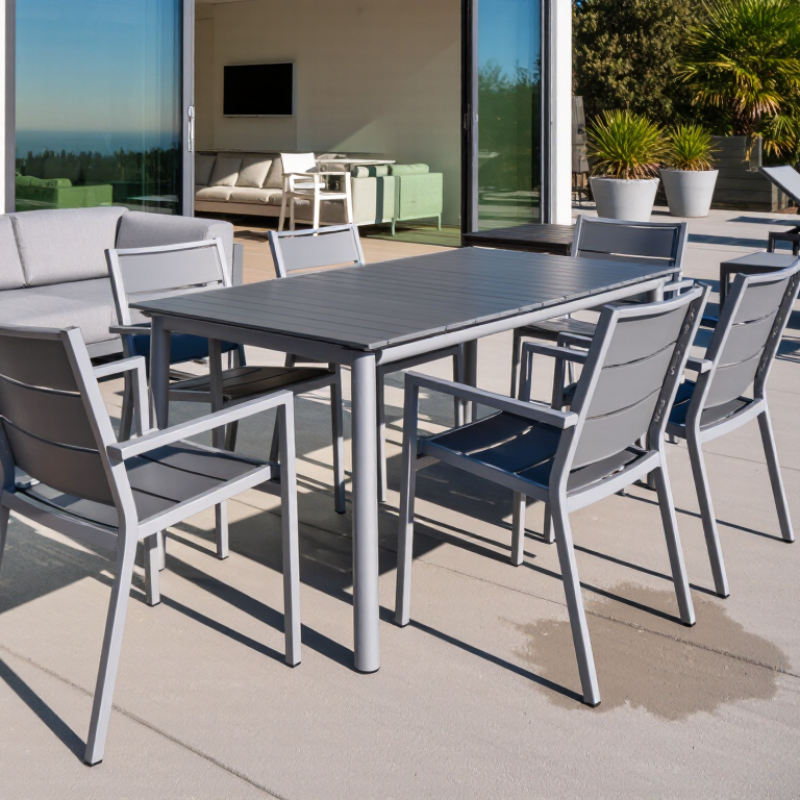
Aluminum furniture suppliers serve global buyers by turning design requirements into repeatable production details. A workable quotation should specify alloy, frame thickness, finish, load capacity, and tolerances—not just dimensions. Buyers can request a sample chair, inspect welds and surface consistency, then confirm packaging before mass production. Small gaps matter. A few millimeters can affect assembly across a large order. Clear inspection criteria and dated production updates also help buyers catch problems before goods leave the factory.
Shipping is part of the product. UNCTAD’s Review of Maritime Transport 2024 reports that over 80% of world merchandise trade by volume moves by sea, making container planning and port schedules central to delivery. Suppliers should provide carton dimensions, loading plans, and realistic lead times; buyers should check these against warehouse access and seasonal demand. Material claims need equal care: the International Aluminium Institute reports that roughly 75% of all aluminium ever produced remains in use. Still, recycled content and production impacts vary by product. Ask for supporting records. A supplier’s polished catalogue is not proof. It is easy to overlook this.
A dependable aluminum furniture supplier should explain the alloy, wall thickness, and finish used for each product. These details affect weight, strength, and resistance to outdoor wear. Ask for technical data sheets and confirm that quoted specifications match the sample. A smooth coating matters, but inspect the joints too. Look for even welds, stable legs, and no sharp edges. Looks can mislead.
Evaluate quality controls through concrete records, not broad promises. Request inspection reports, load-test results, and details about how surface defects are handled. Check whether the supplier can maintain consistent dimensions across repeat orders. Also review production capacity, realistic lead times, export packaging, and after-sales procedures. A low quote may exclude testing or protective packaging. Compare like with like.
Clear communication is another useful measure. Send a few specific questions and note whether answers are timely and precise. Request references for comparable products, while recognizing that references alone cannot guarantee future performance. If a supplier avoids sharing basic specifications, pause and investigate. Even a careful review has limits; samples may not reveal every production issue.
Export-focused manufacturers typically offer dining sets, loungers, and stackable chairs, with export packaging and container planning. Ask for carton dimensions and loading photos. Outdoor specialists focus on powder-coated frames, drainage, and weather-resistant fittings. Inspect finish samples closely; small chips can expose weak coating preparation. Custom fabricators adapt frame dimensions, colors, and table sizes for project specifications. Their flexibility may mean longer lead times. Confirm drawings before production. Contract-furniture suppliers serve hotels and commercial spaces, where repeated-use testing and replacement parts matter. Request test reports, not only catalog claims. Extrusion-based producers control frame profiles and can offer consistent sizing. Check welds, corner joints, and wall thickness.
Hospitality-focused suppliers often pair aluminum frames with woven or upholstered details. Ask how fabrics and cushions are packed for shipment. OEM-oriented factories can manufacture to buyer specifications, but communication needs careful documentation. Keep approved samples and revisions on file. Sustainability-focused suppliers may use recycled aluminum; verify material claims and available traceability records. Small-batch workshops suit distinctive designs and limited orders, though unit costs can be higher. Integrated producers handle cutting, welding, finishing, and assembly in one facility, which can simplify quality checks. Still, a polished showroom does not prove consistent output. Details matter. Compare sample workmanship, inspection procedures, spare-part support, and delivery records before placing an order. These profiles describe supplier types, not guarantees; the right fit depends on product use, budget, and service expectations.
An aluminum furniture supplier should be compared by more than catalogue size. Check whether its range covers dining chairs, loungers, tables, and contract seating, then look closely at frame profiles, finishes, and available sizes. A large selection is useful only if the products share consistent construction quality. Ask for specification sheets and close-up photos of joints, welds, and surface finishes. Details matter.
Customization can mean a small change or a new design. Ask suppliers to distinguish standard options from engineered modifications, such as altered dimensions, fabric choices, or a different powder-coat color. Request drawings, sample approval steps, and clear information about tooling costs and minimum order quantities. That sounds simple. It isn’t. A custom finish may affect lead time, and a requested frame change can require new testing.
Production capacity needs evidence, not just a monthly figure. Ask how many lines handle aluminum furniture, what typical lead times look like during peak season, and how orders are inspected before packing. Photos of the workshop can help, but they do not prove repeatability. Request recent production samples or inspection records where available. I would avoid treating the largest stated capacity as the best choice; reliable scheduling may matter more, especially when product variations share one shipment.
Alloy selection is one useful part of comparing aluminum furniture suppliers. The chart shows representative nominal densities, not supplier rankings or production-capacity data. Actual values vary slightly with alloy composition.
A useful shortlist of aluminum furniture suppliers should compare more than unit price. Request a quote that separates frame material, surface finish, hardware, packaging, and tooling costs. Confirm the stated aluminum grade and finish in writing, then compare them with a physical sample. Ask for relevant test reports and product documents for your destination market. Requirements can differ, so verify them with your local importer or a qualified compliance adviser.
International logistics can change the real cost quickly. Ask for packed dimensions, pallet details, loading photos, and a realistic production schedule. Clarify who arranges export documents, cargo insurance, and delivery under the agreed shipping terms. For a coastal delivery, protective wrapping and dry packing matter; salt air can mark exposed surfaces. A supplier may quote an attractive price but overlook replacement parts or spare hardware. That happens. I have seen small omissions create delays that cost more than expected.
Tips: Compare total landed cost, not just the factory price. Keep one approved sample for reference, and record finish, measurements, and packaging expectations. Add time for inspection and port delays. A neat spreadsheet helps, though it will not predict every surprise.
How to read this shortlist: These are anonymous regional supplier profiles, not named or ranked companies. Price, MOQ, and lead-time figures are indicative planning ranges for a standard powder-coated aluminum outdoor dining chair without cushions; actual quotations depend on specifications, order volume, finish, packaging, and delivery terms.
| Supplier Profile | Typical Strength | Indicative FOB Price per Chair (USD) | Typical MOQ | Indicative Production Lead Time | Compliance Checks for Buyers | Common Export Logistics | Best Fit |
|---|---|---|---|---|---|---|---|
| 01. Large-scale coastal China OEM | Broad product range, established export workflows, and capacity for coordinated furniture sets. | $20–$45 | 300–800 units | 30–50 days after approved samples and deposit | Request product-specific test reports, material declarations, and any applicable quality-system certificate. For EU outdoor seating, assess relevant EN 581 requirements; verify report scope and model coverage. | Commonly quoted FOB from major coastal ports; compare FCL and LCL costs and confirm carton dimensions before booking. | Buyers seeking volume, variety, and consolidated orders. |
| 02. Vietnam contract-manufacturing profile | Export-oriented production and contract manufacturing for outdoor furniture programs. | $24–$50 | 300–800 units | 35–60 days | Confirm factory identity, country-of-origin documentation, product test reports, and the exact scope of any claimed certification. Check destination-market chemical and labeling requirements. | Sea freight commonly routes through major Vietnamese container ports; sailing schedules and transit time depend on destination and carrier. | Importers diversifying production across Asian sourcing locations. |
| 03. India metal-fabrication profile | Metalworking capability, customizable frame designs, and potential for mixed-material construction. | $22–$55 | 300–1,000 units | 45–75 days | Specify alloy and temper, welding requirements, coating thickness, and inspection criteria. Request relevant test reports and verify that documents refer to the supplied model and materials. | Export may move through western or southern Indian ports; obtain a complete landed-cost estimate, including inland haulage and port charges. | Buyers needing custom metalwork or flexible product engineering. |
| 04. Turkey regional manufacturer | Regional production serving nearby markets, with a mix of made-to-order and repeat designs. | $32–$70 | 150–500 units | 30–55 days | For EU sales, confirm applicable product-safety obligations and request test documentation for the actual furniture model. Check customs classification and origin documents with a broker. | Sea, road, or combined transport may be available depending on destination; compare transit time and border procedures for each route. | Buyers serving Europe, the Middle East, or nearby markets who value route flexibility. |
| 05. Central European production profile | Shorter regional replenishment routes and access to European packaging and component supply chains. | $45–$90 | 100–300 units | 25–45 days | Request applicable product testing, traceability records, and declarations for market-specific requirements. A supplier's quality-system certificate does not by itself certify a furniture product. | Road freight is often practical for nearby European destinations; rail or sea options depend on origin, destination, and shipment size. | Buyers prioritizing regional replenishment and smaller repeat orders. |
| 06. Italian design-led manufacturer profile | Design-focused collections, finish options, and higher-specification product development. | $60–$130 | 50–200 units | 30–60 days | Review applicable outdoor-furniture performance reports, coating specifications, material documentation, and product labeling. Confirm whether testing covers the exact configuration ordered. | European road freight or export sea freight; protective packaging and freight class can materially affect delivered cost. | Buyers targeting design-led, premium, or hospitality projects. |
| 07. Iberian outdoor-furniture profile | Outdoor-oriented ranges and access to European distribution routes. | $45–$100 | 100–300 units | 30–55 days | Ask for model-specific durability and safety test reports, coating details, and documentation relevant to the destination market. Verify any environmental claims with supporting evidence. | Road freight can suit European deliveries; sea freight may be used for other regions, subject to route and shipment size. | Buyers sourcing outdoor collections for European retail or contract projects. |
| 08. Mexico nearshore manufacturing profile | Potentially shorter replenishment routes for North American buyers, depending on factory location and border arrangements. | $35–$80 | 100–400 units | 30–60 days | Confirm country of origin and applicable customs rules rather than assuming preferential duty treatment. Request product-specific safety and material documentation for the destination market. | Cross-border truck freight may suit some North American routes; ocean freight and inland transport may be more suitable for others. | North American buyers evaluating regional sourcing and replenishment options. |
| 09. North American domestic manufacturer profile | Domestic communication and delivery options, with potential advantages for smaller replenishment orders. | $60–$140 | 50–250 units | 20–45 days | Confirm applicable national and state or provincial requirements, product test evidence, warranty terms, and the origin of major components. | Domestic truck or parcel freight; compare shipment size, residential or commercial delivery needs, and packaging requirements. | Buyers valuing domestic sourcing, shorter delivery chains, or smaller orders. |
| 10. Gulf-region assembly and distribution profile | Regional stock or assembly options may support nearby projects; available local production depth varies by supplier. | $40–$100 | 100–500 units | 20–45 days for available stock or assembly; made-to-order timing varies | Distinguish locally made products from re-exported goods. Request origin, material, and product-test documentation, and check import rules in the final destination country. | Regional truck and sea routes may be available; verify stock location, re-export paperwork, and handling charges before purchase. | Buyers serving Gulf and nearby markets or seeking regional stock options. |
Buyer due diligence: Prices exclude freight, insurance, duties, taxes, cushions, and project-specific packaging unless stated otherwise. Lead times generally exclude sampling, tooling, holidays, and transit. For outdoor furniture, request model-specific performance testing where applicable (for example, the relevant parts of EN 581 in Europe); corrosion test methods such as ISO 9227 or ASTM B117 are not, by themselves, proof of a particular service life. Confirm the applicable market rules, test scope, certificate validity, Incoterms® 2020, carton measurements, and total landed cost before placing an order.
Ask for the alloy, frame thickness, finish, load capacity, tolerances, packaging, and tooling costs. A price alone is not enough.
A sample lets you check welds, surface finish, measurements, and assembly. Keep it as a reference. A few millimeters can matter.
Ask which changes are standard and which need engineering, such as new dimensions or a different powder-coat color. Confirm drawings, sample approval, tooling costs, minimum quantities, and lead-time effects.
Ask about production lines, peak-season lead times, and inspection records. Workshop photos are useful, but they do not prove consistent output.
Review specification sheets and close-up photos of joints, welds, and finishes. A wide catalogue can look impressive. Consistency matters more.
Request supporting records for material and recycled-content claims. Ask for relevant test reports and product documents, then verify destination-market requirements with a qualified adviser.
Request carton dimensions, pallet details, loading plans, realistic schedules, and clear responsibility for export documents and cargo insurance. Allow time for port delays.
Compare the full cost, including packaging, freight, inspection, and spare hardware. For coastal delivery, ask about protective wrapping and dry packing. Small omissions can cause expensive delays.
This article explores how Aluminum Furniture suppliers support global buyers through dependable sourcing, adaptable product options, and coordinated international service. It outlines practical criteria for evaluating potential partners, including product quality, material consistency, manufacturing expertise, communication, and the ability to meet project requirements. Profiles of ten leading supplier types illustrate the range of capabilities available, from standard outdoor collections to specialized, made-to-order furniture.
The comparison considers product range, customization options, production capacity, and the flexibility to handle different order volumes and timelines. It also explains how buyers can assess pricing beyond the unit cost, review relevant quality and compliance documentation, and plan for shipping, packaging, lead times, and delivery coordination. Together, these considerations offer a clear framework for choosing a supplier that fits a buyer’s needs and supports a smooth, reliable purchasing process.

JIANGYIREN Furniture